
How to become a professional graphic designer? This is the question that is the starting point for many artists in the digital world. In an era where visual content is the first language of communication, graphic design has evolved from a simple skill to a strategic specialty that determines the boundary between the success or failure of a brand. To reach the peaks of this profession, mastering the tools alone is not enough, you need a smart combination of theoretical knowledge, endless creativity and a deep understanding of the market’s needs. In this article, we will explore the answer to the question of how to become a professional graphic designer? Stay with us.
How to become a professional graphic designer?
Becoming an expert in the world of digital arts is a path that goes beyond just learning software. If you’re wondering how to become a professional graphic designer, it’s a combination of art, strategy, and persistence. Join us as we explore this path:
Mastery of artistic fundamentals and design theory
Many people mistakenly assume that the starting point is learning Photoshop. But the real answer to the question of how to become a professional graphic designer lies in a deep understanding of the basics. You need to familiarize yourself with vital concepts such as color theory, typography, composition, and Gestalt psychology. A professional designer knows why a certain color inspires trust in the mind of the audience or how visual balance can guide the viewer’s gaze. Without this foundational knowledge, your designs will simply be beautiful, but they will not look functional or standard.
Strategic learning of industry standard software
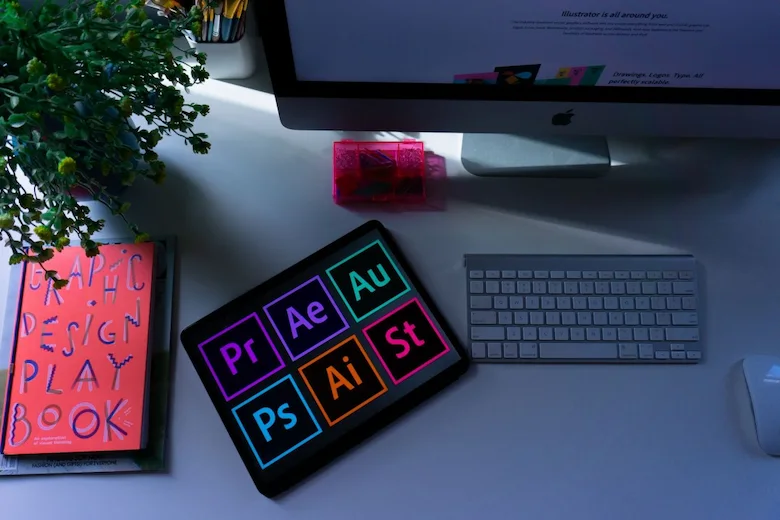
Software is your tool, and mastering it will determine the speed and quality of your output. To learn how to become a professional graphic designer, you need to learn the Adobe suite (including Photoshop, Illustrator, and InDesign) on a project-based basis. Photoshop is essential for editing raster images, Illustrator for designing logos and endless vectors, and InDesign for page layout. The important thing is to focus on learning the execution techniques and shortcuts that will make your workflow more efficient and professional.
Building a targeted and specialized portfolio
Your portfolio is a showcase of your skills and will demonstrate your capabilities more than any degree. On the path to answering the question of how to become a professional graphic designer, you should showcase a collection of your best work on platforms like Behance or a personal website. Instead of posting dozens of mediocre works, try to present 5-10 high-level projects explaining the problem and the design solution. Showing the thought process from initial sketches to the final output proves to employers that you are a problem solver, not just a software operator.
Analyzing superior works and enhancing visual vision
One of the most important steps in answering the question of how to become a professional graphic designer is to develop a design eye. You should analyze the work of the world’s great designers on sites like Pinterest and Dribbble daily. Don’t just look, but ask yourself why this design is successful? What font is used? How is the spacing between elements managed? By practicing copying first-class works, your hand will be in tune with world standards and over time you can find your own personal style and unique signature in design.
Strengthening soft skills and customer relations
A great graphic designer will never reach the professional level if they can’t sell their idea or understand the client’s needs. To learn how to become a professional graphic designer, you need to learn communication skills, how to accept criticism, and negotiation techniques. You need to be able to defend your design choices while also intelligently applying client feedback. Understanding business and marketing will help you create designs that are not only beautiful, but also drive more sales and grow your client’s brand.
Deep understanding of branding and visual identity concepts
Graphic design is not just about creating a single image; it is part of a brand’s value chain. To understand how to become a professional graphic designer, we need to think beyond a simple design to a visual system. A senior designer knows how to create a unified visual language that delivers a consistent user experience across all platforms, from digital to office set design.
Staying up to date with current trends and emerging technologies
The digital world is changing at a breakneck pace, and standing still means being left behind. In order to become a professional graphic designer, you need to keep your finger on the pulse of the market. From modern, minimalist logo design to the clever use of AI tools to speed up ideation, they should all be on your radar. Professionals learn how to use global trends to create lasting icons so that the client’s visual identity always remains modern and attractive.
Focus on printed outputs and promotional materials
Today, a successful designer must master print standards in addition to the digital world. One of the key answers to the question of how to become a professional graphic designer is learning the differences between RGB and CMYK color modes and managing white space on pages. For example, in brochure and catalog design, you need to know how to organize a large amount of information into neat categories so that the audience does not get bored. Mastering professional layout and page layout will greatly increase the value of your services in large industrial and commercial projects.
Specializing in environmental and small print sectors
Many designers try to be versatile when they first start out, but specializing in high-demand niches is a shortcut to success. To understand how to become a professional graphic designer, you need to master the projects that create the physical identity of a business. The skill of designing a business card that, while simple, fits all the aesthetic principles and contact information into a small format, or banner and poster design for urban spaces, requires a high level of precision and finesse that can only be achieved by focusing on these specific niches.
Continuity in learning and managing visual campaigns
An important part of answering the question of how to become a professional graphic designer lies in understanding the ultimate goal of design: attracting customers. A professional designer should not only think about beauty, but also act in the field of advertising design in such a way that the brand’s message is conveyed to the audience as quickly as possible. Learning how to estimate the time for the implementation of advertising projects and manage multiple orders at the same time will make you a reliable specialist.

Final Words
As you can see, in this article, we have thoroughly examined the answer to the question of how to become a professional graphic designer. We learned that becoming a prominent figure in the world of design is not a sudden event, but the result of a continuous and purposeful learning process. By strengthening your visual vision, mastering print and digital standards, and becoming an expert in key areas, you can establish your position in this competitive market. Remember that every big project started with a simple sketch. So, relying on discipline and creativity, build your professional path today and let your works speak for you. Thank you for your support.
At Amood Design and Branding Group, we specialize in office set design, banner and poster design, brochure and catalog design, logo design, and other processes related to digital marketing. Dear friends, you can contact us through communication bridges for more information or to receive free advice.