Motion graphics is a very popular and influential branch of digital design that conveys complex concepts in a simple and visual language by creatively combining image, sound and movement. This art has become one of the main pillars of visual communication in marketing and advertising in recent years. Businesses use motion graphics to convey their message to their audience in a short, attractive and lasting way. The widespread presence of animated videos on social networks, television commercials and web pages shows that the impact of motion graphics on the audience’s mind is much greater than that of still images or even long texts. If you want to know exactly what motion graphics are, what their applications are and how they are made, stay with us until the end of this article.
What is motion graphics?
Motion graphics actually means moving graphics, a combination of static images, symbols, colors, and sound that uses animation and movement to convey a message to the audience in an understandable and beautiful way. Unlike classic animations, which are mostly story-oriented, motion graphics are usually conceptual, promotional, or informative. In this way, dry and complex data can be transformed into fluid and understandable content. Brands, organizations, and media use motion graphics to introduce services, display products, or express educational messages. High visual appeal, speed of meaning transfer, and efficiency in digital spaces have made motion graphics one of the most important modern marketing tools.
What are the applications of motion graphics?
The applications of motion graphics are too broad to be limited to just one area. The art is used extensively not only in advertising and branding, but also in education, media, entertainment, and even corporate environments. Below, we examine six of its most prominent applications, each of which plays an effective role in a specific industry.
Brand advertising
In the field of advertising, motion graphics are known as one of the most effective ways to introduce a brand. Motion video can showcase a brand’s visual identity in the form of color, movement, and sound. Many reputable brands use motion graphics to showcase their dynamism and create a special experience for their audience. Professional designs in brand advertising increase the longevity in the customer’s mind. Especially when logo design is used in the form of animation, the sense of uniqueness of the brand is multiplied. Today, companies use motion graphics to introduce new services or products, creating a deeper connection with their target market.
Educational content
In digital education, motion graphics are an effective tool for explaining difficult concepts in a simple and visual way. Visual tutorials using movement and visual effects make it easier for the human brain to understand and retain information. For this reason, educational institutions, universities and online learning platforms use motion graphics for their various courses. Even concepts such as science, technology or economics, which are normally difficult, are easier to remember with visual storytelling.
Media and news
One of the important applications of motion graphics is in the field of media and news production. Complex data and statistics are displayed much more effectively with this method. In television news segments or online platforms, motion graphics are used to create animated infographics to explain statistics or time trends. Instead of dry tables and charts, smooth graphic movements make the content easier to understand. Also, in short visual reports on social networks, motion graphics help to convey important information in a few seconds in an attractive way.
Product introduction
Motion graphics are a great way to showcase product features in the e-commerce world. Through animation, companies can visually express how a product works or its benefits. This type of content is very effective for online advertising and campaigns, as it provides complete information without the need for a lot of text. For example, companies that office set design use motion graphics to show how to use and combine colors in their products. Such videos convey a sense of modernity to the brand and increase the desire of customers to buy.
Social networks
In a world of social media where users decide what to see in a matter of seconds, motion graphics have become a vital tool for capturing attention. Short, creative motions cause users to pause while scrolling, providing an opportunity to display the advertising message. These types of videos increase engagement rates and can quickly imprint the ad in the viewer’s mind. Brands often use different styles of motion graphics, such as cutouts, motion typing, or 2D animation, to produce content that fits their visual identity.
Conferences and events
At conferences, festivals or corporate presentations, motion graphics add a professional touch to the event. From opening videos to speaker information displays, motion graphics play a key role. This content helps to display the main messages of the conference more clearly. Motion graphics are also used to design pre-program promotional teasers and create animated backgrounds. Large companies use this method to give their event a formal and modern atmosphere and create a positive visual impact.

What are the applications of motion graphics?
Creating a motion graphics project is like creating a short film and requires creativity, careful planning, and coordination between various specialties. Every stage, from ideation to the final output, has a direct impact on the quality of the work. In this section, we will examine the seven main stages of creating professional motion graphics, the sequence of which, if followed, will lead to impressive results.
Ideation and goal setting
The first step in creating a motion graphic is to identify the goals of the project. It should be clear what purpose the video is being created for: education, advertising, or brand introduction? At this stage, the designer’s mind is free to create different ideas, choose colors and visual styles, and imagine the direction of movement in his mind. The more creative the idea, the greater the final impact of the video. For this reason, the ideation stage is the most basic and important part of creating a successful motion.
Scenario writing
At this stage, the writer or director of the motion graphics project writes the story and main message of the work. The exact script determines the order of events, the angle of view, the timing, and how elements enter and exit. The text written in this section should be both appropriate to the project’s purpose and visually executable. In advertising projects, the tone of the script is usually faster and with shorter sentences to convey the message more clearly. The execution of a good script is the basis of coordination between the design and sound departments.
Storyboard design
A storyboard is a graphic representation of a scenario text in which the main frames and movements of the motion graphics are drawn before final production. This stage is considered like a technical plan for the project and allows the client and designer to gain a precise understanding of the project’s execution path. In this section, everything from character placement to camera movement and display time is reviewed. Having a strong storyboard reduces errors in the final execution and saves time and money.
Graphic design
In this step, graphic designers create the visual appearance of the motion graphics project. Icons, backgrounds, color schemes, and typography are designed at this stage. High-quality design has a direct impact on the audience’s perception and can make the brand appear more authentic. Also, in banner and poster design projects, this stage is the key to visual success, as the color combination and coordination between components must be in a way that does not tire the viewer’s eye and increases the attractiveness of the work.
Animating elements
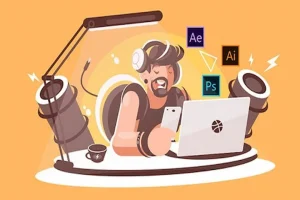
After the design, the visual elements must come to life. In this section, specialized software such as After Effects and Blender are used to create smooth and realistic movements in motion graphics. Designers adjust the process of each object entering and leaving, the speed, timing, and synchronization with the music. Proper execution of animation requires a sense of rhythm and mastery of the physical principles of movement so that the final image looks natural and impressive.
Voiceover and sound effects
Sound effects and music are the soul of motion graphics. The right sound can guide the audience’s emotions and multiply the energy of the video. The choice of background music should be consistent with the tone and purpose of the project; for example, rhythmic music is used to promote modern products, and a quieter sound is used for educational content.
Output, editing and final review
In the final stage, the motion graphics video is output and the editor makes final adjustments by carefully checking the details. Lighting, color, sound coordination, and framing are among the most important things that are controlled at this stage. The final file is output in various formats suitable for the publishing platform such as Instagram, website, or TV. A careful review before publishing can elevate the quality of the project from an ordinary video to professional-level content.

Motion graphics production fee
The price of motion graphics depends on a variety of factors, from the complexity of the content, the length of the video, and the style of the design to the animation and voiceover. Projects with unique designs, custom characters, or special visual effects naturally cost more. The output quality, resolution, and turnaround time also affect the price. Companies that want to provide detailed and differentiated content usually use professional graphic designers and will pay more. When the design is based on brochure and catalog design standards and the visual detail is at a high level, the motion graphics rate increases, but it results in a professional and lasting result.
Final Words
Finally, it must be said that motion graphics is an art between image, time and emotion. Combining movement and sound in graphic design not only makes concepts more quickly understood, but also helps to better consolidate the message in the viewer’s mind. In today’s world, where competition is fierce in attracting user attention, motion graphics can be the winning card of any brand. With a precise understanding of the applications, production stages and principled investment, videos can be created that are not only beautiful but also effective. If creativity, purposeful design and storytelling are combined correctly, the result will be a lasting work of art that will imprint your brand well in the minds of the audience.
At Amood Design and Branding Group, we specialize in banner and poster design, logo design, office set design, brochure and catalog design, etc. Dear friends, you can contact us through communication bridges to obtain more information and receive free advice.